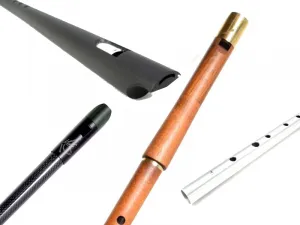
The piper’s grip has kept the low D whistle out of reach for too many players for too long. Here’s a guide to every instrument designed to fix that — including two exciting new arrivals.
If you’ve ever picked up a low D whistle and immediately wondered how anyone is supposed to reach those bottom holes, you’re not alone. The low D is one of the most beautiful instruments in Irish and Celtic folk music — that rich, breathy, twilight tone is unlike anything else — but it comes with a physical challenge baked in. The standard hole spacing demands the piper’s grip, a technique where the pads rather than the tips of your fingers cover the tone holes, and even with perfect technique the stretch is significant. For players with smaller hands, shorter fingers, arthritis, or hypermobility, it can feel genuinely impossible.
The good news is that instrument makers have been quietly working on this problem for years, and the options available to players right now are better than they have ever been. This guide runs through every serious close-spacing or ergonomic low D on the market — from the well-established to the brand new.
Why Is Close-Spacing Needed?
A standard low D whistle is a long instrument, and the physics of that length means the tone holes end up spaced quite far apart. The E hole (the lowest tone hole) in particular tends to sit at an awkward distance from the D hole above it. Makers have traditionally compensated by making the E hole smaller and positioning it slightly off where pure acoustics would place it, so that the piper’s grip becomes viable. The result is a workable technique — but one that still demands a reach that many players simply can’t manage comfortably.
A handful of instrument makers have tackled this differently, by genuinely bringing the holes closer together rather than asking the player to stretch further. The results vary in approach and price, but there are now several options available.
1. The Compass Low Blow

The Compass Low Blow is a newer arrival and, in several ways, a quietly radical one. It’s 3D-printed in England from plant-based PLA, comes in three parts, and — crucially — is the most affordable tuneable low D on the market. The ability to tune it to the room is a real-world necessity for session playing, and until recently that feature came at a significant cost premium.
The ergonomic feature on the Low Blow is a rotatable bottom hole: the lowest tone hole can be turned around the body of the instrument to create an offset position tailored to your hand. This is a different approach from full close-spacing — it’s about adjusting the instrument to your grip rather than redesigning the hole layout entirely — but it makes a genuine difference, particularly for the stretch to that lowest note.
The tone is gorgeous and breathy, with a surprisingly mature voice for an instrument at this price. It comes with a handmade felt case that also fits a high penny whistle alongside it. For anyone curious about the low D who has been put off by price or tuning limitations, the Low Blow is a compelling entry point — and a capable gigging instrument at the same time.
2. Howard Close-Spacing Low D

The game-changing Howard Music Close-Spacing Low D Whistle uses specially designed internal chimneys within the bore to allow the external tone holes to sit much closer together than the acoustic geometry would normally permit. The result is a full close-spacing instrument — not a partial workaround — at a price that starts at £180.
That price point matters enormously. Until now, if you wanted a genuine close-spacing low D, you were looking at the Carbony and not much else. The Howard brings that technology within reach of intermediate players, students, and session musicians who aren’t in a position to spend at the top of the market. It is a well-engineered instrument from a maker with a strong reputation in the whistle world, and it represents the most significant new arrival in the low D market in some time.
3. Burke EZ Low D

Michael Burke’s Pro Viper is one of the most respected low D whistles on the market — renowned for its strong, clear tone, reliable intonation, and soulful character. The EZ is Burke’s ergonomic variant, featuring the bottom two tone holes positioned closer together and made slightly smaller in diameter, specifically to make that lowest reach easier for players with smaller hands. It shares the same tonal character and tuning as the standard Pro Viper, with a small trade-off: the E note is slightly weaker as a result of the modified placement, though most players find this entirely manageable in practice.
The Burke EZ sits at £430, and is also available in brass and composite variants. It is a serious, professional instrument with a long track record — for players who want a well-established name and a proven instrument, it remains a very solid choice. It is worth noting, however, that the EZ offers a partial ergonomic solution — the hole spacing is reduced but not as dramatically as in the full close-spacing instruments mentioned in this article.
4. Carbony Close-Spacing Low D

For many years, the Carbony has been the definitive answer to the “I can’t reach the holes” problem. It uses a different internal geometry to bring all the tone holes significantly closer together, making it genuinely playable for people who find a standard low D impossible. The tone is excellent — warm, full, and characterful — and players who own one tend to be fiercely devoted to it.
The Carbony remains a benchmark instrument and rightly respected. The main barrier is cost: it sits at a premium price that puts it well beyond what many players are willing or able to spend. For those who can stretch to it, it delivers. For everyone else, the landscape has recently become much more interesting. Please note the big bore and standard bore alternatives.
5. Howard Keyed Close-Spacing Whistle

Howard Music’s keyed close-spacing whistle is a brilliant and novel solution to the challenge of low whistle ergonomics. Available with either one or two keys, this was David O’Hagan’s original solution to the challenge. By using keys, like those you would find on a flute or saxophone, the difficult-to-reach finger holes become easily accessible.
Howard’s keyed whistle looks totally unique, and is extremely playable, and retains the distinctive tone of the Howard classic low D that we know and love. The only downside is that price-point, which is necessitated by the use of the top-quality keys.
How Do They Compare?
| Burke EZ | Carbony | Compass Low Blow | Howard Close-Spacing | Howard Keyed Whistle | |
|---|---|---|---|---|---|
| Close-spacing method | Hole placement | Full close-spacing | Rotatable bottom hole | Full close-spacing | Keys |
| Tuneable | Yes | Yes | Yes | Yes | Yes |
| Price range | £430 | £530 and upwards | £75 | £180 and upwards | £350 and upwards |
| Material | Aluminium / Brass | Carbon fibre | Plant-based PLA | Brass + ABS resin | Brass + ABS resin |
Which One Is Right for You?
If you’re coming to the low D for the first time and want a tuneable, affordable instrument you can explore without a major financial commitment, the Compass Low Blow is an easy recommendation. The rotatable bottom hole won’t suit every player’s needs, but the price, the tuneability, and the quality of tone make it exceptional value.
And if your problem is genuinely ergonomic — if you’ve tried a standard low D and found it physically unmanageable — the Howard Close-Spacing Low D is an incredible option. Full close-spacing at £180 is a different proposition from anything that has existed before.
If you want an established, highly regarded instrument with a partial ergonomic improvement and exceptional tone, the Burke EZ is a proven option. It won’t solve the problem for everyone, but for players who are close to managing a standard low D and just need a little help, it may be exactly right.
If budget is no object and you want the original, full close-spacing instrument, the Carbony remains hugely popular, and much-loved. Players who own one rarely look back.
The low D has been, for too long, an instrument with an unspoken entrance requirement: either accept the physical challenge, or spend a lot of money on a solution. That is changing. The arrival of the Howard and the accessibility of the Compass Low Blow mean that more players than ever before have a genuine path to this remarkable instrument — and that is worth celebrating.